FIDE Speaking Test Levels: A1, A2 and B1 Differences with Examples
FIDE test language levels explained: summary
This article summarises what is expected at each speaking level of the FIDE test (A1, A2 and B1), based on the Common European Framework of Reference for Languages (CEFR). It gives you a clear idea of the key differences between these levels, with example responses and what examiners look for.
Whether you’re preparing for the FIDE test for a permit, for naturalisation or out of personal interest, understanding the A1, A2, B1 progression helps you aim for the right language level.
This article covers only the oral part, and mainly the speaking section. For every task of the exam explained step by step, read our FIDE oral exam guide.

Each level reflects descriptors from the CEFR framework (the Common European Framework of Reference), which is used by language tests across Europe as a common scale for measuring language skills. The CEFR framework describes six levels, from A1 to C2; the FIDE test covers the first three.
Label and respond
Single words and phrases, heavy help from images and the examiner.
Describe and function
Simple linked sentences, routine tasks, mistakes tolerated.
Explain and discuss
Opinions, reasons and hypotheses, with structured answers.
| Criterion | A1 | A2 | B1 |
|---|---|---|---|
| Main goal | Label and respond | Describe and function | Explain and discuss |
| Sentence length | Single words and phrases | Simple linked clauses | Full, structured sentences |
| Fluency | Halting | Uneven but self-correcting | Generally smooth |
| Grammar | Bare minimum | Basic tenses and agreement | Range of tenses, some complex sentences |
| Vocabulary | Everyday, concrete | Functional, expanding | Abstract ideas, opinions |
| Coherence | Low | Moderate (with connectors) | High (structured ideas) |
| Interaction | Heavily assisted | Some autonomy | Can keep a conversation going |
| Typical speaking time per question (our experience) | 10–20 seconds | 30 seconds to 1 minute | About 40 seconds to 2 minutes, plus follow-ups |
A2 vs B1: what A1, A2 and B1 mean on the FIDE speaking test

When measuring language ability, it’s tempting to believe that levels like A1, A2 and B1 are neat staircases of progress: more words, better grammar, longer sentences. In reality, language learning is less like climbing a ladder and more like wiring a city: complex and messy, but with patterns you can observe.
The speaking or “Parler” section of the FIDE test is used to assess the language skills of non-Swiss residents applying for Swiss residence permits or citizenship, and it is built around this complexity. Based on real-life scenarios, it doesn’t just ask “What do you know?” but “How can you act and respond using language flexibly?” It’s less about memorising rules and more about responding appropriately in everyday situations, using language related to everyday needs and familiar topics.
For language learners, this is good news. In theory, test-takers are not taken outside their daily comfort zone or asked about topics they are unlikely to have come across. The test stays on everyday topics: work, family, shopping, appointments, free time.
How the levels work on exam day
Everyone starts the speaking exam with the A2 tasks. Depending on how those go, you then continue at A1 or move up to B1. The speaking result counts for two thirds of your oral grade, and the comprehension (listening) section for one third. The speaking part lasts about 15 minutes. (FIDE test manual, May 2026)
So what distinguishes an A1 from an A2 or a B1 speaker on the FIDE test?
Let’s map out the differences, with descriptors taken from the official FIDE test manual and example responses written by our instructors. The levels range from basic phrases used to name things at A1 to more independent language use at B1.
A1Level A1: naming things, one word at a time

« Peut utiliser des mots et des expressions simples et isolés pour nommer des lieux, des situations ou des actions. » (FIDE test manual)
“Can use simple, isolated words and expressions to name places, situations or actions.” (Our translation)
What A1 speaking looks like
At A1, the speaker builds proto-communication: very basic phrases and familiar everyday expressions. This includes basic personal information like name, age, nationality and daily habits. It’s not structured conversation, but labelling and reacting: “C’est un bus… une école… je vais au travail.”
At this level, you can use single words and very simple phrases. Given the setting, the person listening to you can guess what you want to say. You rely on the images and on the examiner’s prompts.
A1 task format
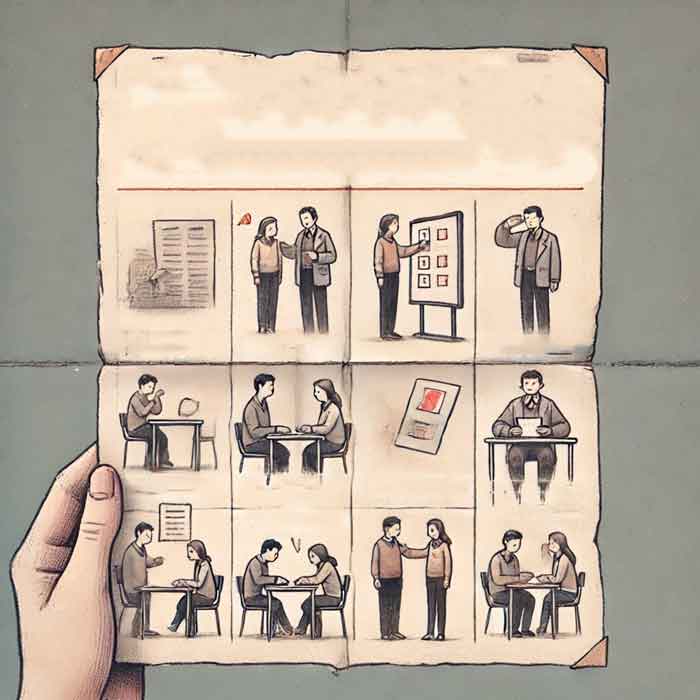
- Task 1 (description): a series of four images shows an everyday action, for example going to the post office. You name the people, places and actions you see, using simple words or short phrases.
- Task 2 (interaction): using the same images, you react to the examiner, for example by saying what a person in the picture is saying.
« Cette personne dit : Bonjour, vous pouvez m’aider s’il vous plaît ? Que dit cette personne ? » “This person says: Hello, can you help me please? What is this person saying?”
From our experience, each response at A1 lasts about 10 to 20 seconds.
A1 linguistic features
| Feature | A1 expectation |
|---|---|
| Vocabulary | Frequent, concrete nouns and verbs related to basic personal topics (bus, acheter, école) |
| Grammar | Basic forms, telegraphic speech, many errors |
| Fluency | Slow, many pauses, mostly reactive |
| Coherence | Minimal: phrases are rarely linked |
| Pronunciation | Intelligible is enough; a strong accent is fine |
The examiner understands the intention through key words, even though the grammar is missing. At A1, that is what counts: one sentence doesn’t need to be complete for the overall meaning to come across.
A2Level A2: describing and getting things done

« Peut décrire une situation ou un événement en enchaînant des éléments isolés de façon simple. » (FIDE test manual)
“Can describe a situation or event by linking isolated elements in a simple way.” (Our translation)
« Peut relater de façon brève et simple des expériences, des événements ou des activités. » (FIDE test manual)
“Can briefly and simply recount experiences, events or activities.” (Our translation)
What A2 speaking looks like
At this level, the speaker starts to structure thoughts and communicate them with some autonomy. A2 candidates can describe an image, handle a routine exchange such as a phone call, and describe experiences and habits in simple language, even with noticeable grammar mistakes.
What the FIDE test manual says about errors at A2
« L’adéquation de l’expression est considérée comme plus importante que la correction grammaticale. » (FIDE test manual)
“Whether the expression fits the situation is considered more important than grammatical accuracy.” (Our translation)
« Les participantes et participants utilisent généralement correctement des structures de phrase simples, mais continuent à commettre de manière systématique des erreurs élémentaires. » (FIDE test manual)
“Candidates generally use simple sentence structures correctly, but still make basic errors systematically.” (Our translation)
In other words, correct grammar is not the goal at A2. You can make repeated basic errors and still reach A2, as long as:
- your sentence structure supports the message
- what you say has some internal logic
- what you say fits the situation (making a phone call, describing a picture)
A2 task format
- Task 1: describe an image. « Que se passe-t-il sur cette image ? » (“What is happening in this image?”)
- Task 2: a simulated phone call (role-play). « Vous téléphonez pour annuler un rendez-vous chez le médecin. Vous expliquez pourquoi. » (“You call to cancel a doctor’s appointment and explain why.”) This role-play mirrors a simple, direct exchange from real life.
- Task 3: talk about your experiences and habits. « Que faites-vous tous les jours ? » (“What do you do every day?”)
Example responses by level, with acceptable A2 mistakes
Task 1: describe an image. A woman is at the pharmacy, speaking to a staff member.
| Level | In French | In English |
|---|---|---|
| A1 | Pharmacie. Femme. Parle. Médicament. | “Pharmacy. Woman. Talking. Medicine.” |
| A2 (correct) | La femme est à la pharmacie. Elle parle avec le pharmacien pour acheter des médicaments. | “The woman is at the pharmacy. She is talking to the pharmacist to buy medicine.” |
| A2 (with acceptable mistakes) | Elle dans pharmacie. Elle demande médicament pour mal tête. | “She in pharmacy. She ask medicine for head pain.” |
| B1 | La femme est probablement malade. Elle demande conseil au pharmacien pour choisir un médicament adapté. Peut-être pour un rhume ou une allergie. | “The woman is probably sick. She’s asking the pharmacist for advice to choose the right medicine. Maybe for a cold or an allergy.” |
Despite missing articles and verb mistakes, the A2 version with errors clearly gets the key information across.
Task 2: phone call to cancel an appointment. You can’t go to your 3 p.m. appointment tomorrow.
| Level | In French | In English |
|---|---|---|
| A1 | Docteur… pas venir… demain. Malade. | “Doctor… not come… tomorrow. Sick.” |
| A2 (correct) | Bonjour, j’ai un rendez-vous demain à 15 heures, mais je suis malade. Je voudrais le déplacer, s’il vous plaît. | “Hello, I have an appointment tomorrow at 3 p.m., but I’m sick. I would like to reschedule it, please.” |
| A2 (with acceptable mistakes) | Bonjour. J’ai rendez-vous demain mais je peux pas venir parce que je malade. Je veux changer pour après-demain si possible. | “Hello. I have appointment tomorrow but I can’t come because I sick. I want change for day after tomorrow if possible.” |
| B1 | Bonjour, je vous appelle pour annuler mon rendez-vous de demain à 15 heures. J’ai de la fièvre et je préfère attendre quelques jours. Est-ce que vous avez une disponibilité vendredi matin ? | “Hello, I’m calling to cancel my appointment tomorrow at 3 p.m. I have a fever and would rather wait a few days. Do you have availability on Friday morning?” |
The errors are there, but the task is done: the appointment is cancelled and a new one is requested.
Task 3: talking about daily life and experiences
| Level | In French | In English |
|---|---|---|
| A1 | Travail. Matin. Bus. Manger. | “Work. Morning. Bus. Eat.” |
| A2 (correct) | Le matin, je me lève à 6h30. Je prends le bus à 7h15 pour aller au travail. Je commence à 8 heures. | “In the morning, I get up at 6:30. I take the bus at 7:15 to go to work. I start at 8 o’clock.” |
| A2 (with acceptable mistakes) | Chaque matin, je levé à 6h30. Je prend bus et je arrive au travail vers huit heure. | “Every morning, I get up at 6:30. I take bus and I arrive at work around eight o’clock.” |
| B1 | Je me réveille toujours à 6h30, mais je prends mon temps le matin. Je bois un café, je lis les nouvelles, puis je pars au travail. Le soir, j’essaie de faire du sport ou de cuisiner quelque chose de sain. | “I always wake up at 6:30, but I take my time in the morning. I drink coffee, read the news, then go to work. In the evening, I try to work out or cook something healthy.” |
The A2 response with mistakes shows a clear sequence of events, even with verb and article errors.
A2 linguistic features
| Feature | A2 expectation |
|---|---|
| Vocabulary | Daily-life vocabulary and familiar topics (rendez-vous, pharmacie, malade) |
| Grammar | Frequent basic mistakes; structure should support understanding |
| Fluency | Short but coherent sentences, some hesitation |
| Coherence | Basic connectors: et puis, parce que, ensuite |
| Pronunciation | Clear enough for the listener to follow without repetition |
| Error tolerance | Grammar and word order errors accepted if the meaning is clear, even with obvious searching for the exact word |
Want to test your level in French? 20 minutes, A1 to B1, no account needed, results shown immediately.
Take the free level testB1Level B1: opinions, arguments and hypotheses

« Peut relater des expériences ou des événements en décrivant ses réactions et en exprimant son opinion. » (FIDE test manual)
“Can recount experiences or events, describing their reactions and expressing their opinion.” (Our translation)
« Peut s’exprimer de manière compréhensible sur des sujets de la vie quotidienne et donner son avis, par exemple, décrire les avantages et les inconvénients d’une situation. » (FIDE test manual)
“Can express themselves understandably on everyday topics and give their opinion, for example by describing the advantages and disadvantages of a situation.” (Our translation)
« Peut décrire de façon simple des rêves, des sentiments ou des objectifs personnels, p. ex. décrire une situation idéale ou prendre position sur une hypothèse. » (FIDE test manual)
“Can describe dreams, feelings or personal goals in a simple way, for example describing an ideal situation or taking a position on a hypothesis.” (Our translation)
What speaking at B1 level looks like
At B1, you use language not only to describe reality but to structure your thinking: explaining, comparing, giving reasons and imagining situations. Your speech becomes more independent, coherent and personal. You can talk about topics of personal or professional interest with more clarity and control, use a wider vocabulary, link ideas with subordinate clauses and express opinions.
Unlike A2, where the focus is on recounting events, the B1 level asks you to organise information, show nuance and respond to open or hypothetical questions clearly and relevantly.
B1 task format
- The examiner proposes two topics and you choose one. Unlike some other B1 exams, there’s no prepared presentation: it’s a guided conversation.
- The examiner then asks open questions on that topic: your experiences, how something works, the advantages and disadvantages, or a hypothetical situation.
- From our experience, each reply lasts about 40 seconds to 2 minutes, and the examiner may ask follow-up questions to clarify your main points.
Example prompt in the style of the test:
« Quelle est la dernière fête à laquelle vous avez participé ? Pourquoi était-elle importante ? » “What was the last celebration you attended? Why was it important?”
Similar questions might ask about your last holiday, your job or where you would like to live.
What the FIDE test manual says about errors at B1
At B1, accuracy matters more, but mistakes are still expected:
« Elles/ils utilisent de manière relativement correcte un répertoire de structures grammaticales de base, même si les erreurs peuvent se multiplier dans les interventions plus longues. » (FIDE test manual)
“They use a repertoire of basic grammatical structures fairly correctly, even if errors can increase in longer contributions.” (Our translation)
So while examiners expect more tenses, connectors and structure, the focus stays on your ability to express and explain opinions clearly, even with grammar slips.
Example responses by level, with acceptable B1 mistakes
Task: describe a celebration. « Parlez d’une fête importante pour vous. Pourquoi est-elle importante ? Quels sont les aspects positifs ou négatifs ? » (“Talk about a celebration that matters to you. Why is it important? What are the positive and negative sides?”)
| Level | In French | In English |
|---|---|---|
| A2 | J’ai fêté mon anniversaire. Il y avait un gâteau. J’ai dansé avec mes amis. C’était bien. | “I celebrated my birthday. There was a cake. I danced with my friends. It was good.” |
| B1 (correct) | Pour mon anniversaire, j’ai organisé une petite fête avec mes amis. J’aime les fêtes simples, car je peux parler avec tout le monde. Les grandes fêtes sont souvent trop bruyantes. | “For my birthday, I organised a small party with my friends. I like simple parties because I can talk to everyone. Big parties are often too noisy.” |
| B1 (with acceptable mistakes) | C’était mon anniversaire et j’ai fait un fête petit chez moi. J’aime pas le grandes fêtes, c’est trop de bruit. Je préfère quand nous peut parle tranquillement. | “It was my birthday and I did a little party at my place. I don’t like big parties, it’s too much noise. I prefer when we can talk calmly.” |
Despite the grammar mistakes (“un fête petit”, “le grandes fêtes”, “nous peut parle”), this response gives a personal opinion and compares two options, which is what B1 asks for.
Task: take a position on a hypothesis. « Si vous deviez déménager dans une autre ville, laquelle choisiriez-vous et pourquoi ? » (“If you had to move to another city, which one would you choose and why?”)
| Level | In French | In English |
|---|---|---|
| A2 | Je veux aller à Lausanne parce que c’est joli. Il y a le lac. | “I want to go to Lausanne because it’s pretty. There’s the lake.” |
| B1 (correct) | Si je devais déménager, je choisirais Lausanne. C’est une ville que j’aime beaucoup, parce qu’elle est calme mais dynamique, et la nature est très proche. Je pourrais me promener près du lac tous les jours. | “If I had to move, I would choose Lausanne. It’s a city I really like because it’s calm but lively, and nature is close by. I could walk by the lake every day.” |
| B1 (with acceptable mistakes) | Je pense que je vais vivre à Lausanne. Parce que c’est une ville très beau, avec lac et montagnes. J’aime pas trop les villes trop grand comme Genève. | “I think I go live in Lausanne. Because it’s a very beautiful city, with lake and mountains. I don’t really like cities too big like Geneva.” |
The conditional is missing and some adjectives don’t agree (“très beau”, “trop grand”), but the reasoning is clear and the opinion is supported by examples.
B1 linguistic features
| Feature | B1 expectation |
|---|---|
| Vocabulary | Expands into abstract ideas: préférence, opinion, avantages, inconvénients |
| Grammar | Present, past tense, future and conditional, subordinate clauses and relative clauses; some errors |
| Fluency | Generally smooth, self-corrects when needed |
| Coherence | Ideas structured with connectors: parce que, alors, d’un côté… de l’autre |
| Pronunciation | Clear and understandable for the listener, even with an accent |
| Error tolerance | Errors accepted as long as they don’t block understanding |
From A1 to B1: the progression in one line

Whereas A1 is about labelling the world, A2 is about getting through it with simple, routine tasks, and B1 is about commenting on it. The progression is not only linguistic but cognitive: from naming, to narrating, to reasoning.
The FIDE test doesn’t assess language skills in isolation. It checks whether you can use the language to take part in everyday life in Switzerland, including giving your views on topics of personal interest. It rewards clarity over complexity and function over form.
How to move from A2 to B1 speaking
Many learners feel stuck at A2, and almost always for the same reason: they understand a lot, but their speaking stays short. Many learners can follow a B1 conversation and still answer it at A2. From our experience, the jump is not about collecting new words; it’s about building longer replies out of the language you already have. If A2 gives you the bricks, B1 is the mortar between them.
That mortar is mostly grammar:
- Past tense. A B1 story mixes the passé composé and the imparfait: “Il pleuvait, alors je suis resté à la maison.” One sets the scene, the other moves the story on. You need the past tense every time you describe experiences.
- Subordinate clauses. Parce que, quand, si, pendant que, bien que. Subordinate clauses turn a list of facts into an explanation. If you only work on one thing, make it this. Grammar complexity also increases with the subjunctive mood, which usually appears at B1 after expressions like il faut que (“il faut que je parte”).
- Relative clauses. Qui, que and où add detail without starting a new sentence: “une ville que j’aime beaucoup.”
- The conditional and modal verbs. Je pourrais, je devrais, je voudrais. You need them for hypotheses, and modal verbs like pouvoir and devoir soften an opinion: “on devrait”, “je ne peux pas”.
- Word order. Pronouns and negations in the right place make complex sentences easier to follow. Word order mistakes rarely block understanding, but they slow the examiner down.
- Useful phrases for opinions. À mon avis, d’un côté… de l’autre, ce que j’aime, c’est…
Why the jump from A2 to B1 feels so big
A2 is an elementary level. You get through routine exchanges with short, simple sentences and a handful of prepared phrases. The B1 level is the first intermediate level: the point where you start using French independently. On paper, it’s one step. In practice, the transition can feel disproportionately large. From our experience:
- At A2, language learners handle routine tasks well, then freeze when a conversation takes an unexpected turn.
- At B1, you have to produce language, not just recognise it. Many learners understand far more than they can say: their listening skills are ahead of their speaking skills.
- B1 needs more vocabulary and better grammar control, because you’re explaining and comparing, not just describing.
How many words and hours? You’ll often read that A2 vocabulary typically includes around 1,000 words, and that B1 requires an active vocabulary of around 2,000 to 2,500 words. Treat these as rough estimates: the CEFR describes what you can do with a language, not how many words you know, and research on French learners shows large differences between groups (LLAS, French and the CEFR). The same goes for study hours. For English, Cambridge English gives about 180–200 hours of study from zero to A2 and 350–400 to B1, as a guideline only (Cambridge English). For French, your background, how intensively you study and how much French you hear outside class matter more than any average.
Common mistakes at B1 in French
- Noun gender: B1 learners often mix up noun genders: “un fête” instead of “une fête”. Learn new vocabulary with its article, never alone.
- Agreement: adjectives and verbs that don’t match (“une ville très beau”, “nous peut”).
- Past and future tenses: mixing up the passé composé and the imparfait, or the futur proche and the conditional.
- Verb placement: pronouns and negations in the wrong place (“je ne pas l’ai vu” instead of “je ne l’ai pas vu”).
These mistakes show up in both speaking and writing. At B1, they are tolerated as long as they don’t block understanding, but the fewer you make, the easier it is for the examiner to follow your reasoning. Work on them with targeted practice rather than general revision.
Practice speaking every week
Language learners with a full time job rarely have hours to spare, and they don’t need them. From our experience, short, regular practice beats a long session once a month. A weekly routine that works:
- Record yourself. Note your key ideas, answer one B1 question for 1 to 2 minutes, then listen back. What’s missing is usually a reason, an example or a word of vocabulary you didn’t have. Listen to the same recording a week later and you’ll hear the progress.
- Practice the real format. Mock exams and model answers show you what the examiner expects before your exam date. Practice the three B1 question types: your experiences, advantages and disadvantages, and hypotheses.
- Act out everyday situations. Calling the doctor, the régie, your child’s school. It’s the closest practice to the A2 phone call task.
- Start with familiar topics. Practice speaking about work, family and free time at your own speed. Then go again at a more natural pace and add an opinion.
- Write new words down. Three after each session, each in a sentence of your own, then use them in your next speaking practice. Writing them down is what makes them stick.
Build your vocabulary by topic
Vocabulary lists don’t stick; vocabulary in context does. The FIDE test stays on familiar topics from everyday life, so learn new words in the clusters you’ll actually use:
| Topic | Key vocabulary |
|---|---|
| Health | rendez-vous, ordonnance, pharmacie, avoir mal à… |
| Work | horaires, collègue, contrat, congé |
| Housing | régie, loyer, déménager, voisin |
| Transport | abonnement, retard, correspondance |
| Opinions | avantage, inconvénient, à mon avis, je préfère… parce que… |
At B1, the opinion vocabulary matters most: it’s what lets you express opinions, compare and justify a choice.
Self study or a teacher?
Self study works well for listening practice, writing and vocabulary. Speaking skills are different: when you practice alone, nobody corrects you, so mistakes settle in. That’s why many learners feel more confident once a teacher corrects them in real time, and why language learners often combine self study with a weekly lesson. If you prepare alone, read our tips on the art of self study.
How long it typically takes to go from A2 to B1 depends on your starting point, how much French you hear outside class and how much you practice. If you want to progress faster, a placement evaluation shows exactly which language skills are holding you back.
Ready to aim for B1? Book a placement evaluation and get a practice plan based on your current level.
Book a placement evaluationWhat about comprehension and the written part?
Like other B1 exams such as the DELF B1, the FIDE test covers reading, writing, listening and speaking skills: the oral part tests speaking and listening, the written part reading and writing. The oral part has two sections: speaking and comprehension. In the comprehension section, you listen to short recordings from everyday life and answer questions about them, at the level that matches your speaking route (A1–A2 or A2–B1). From our experience, each recording is played twice: the first listen gives you the general idea, the second the details. Comprehension counts for one third of your oral grade, so it deserves real listening practice, not just whatever you catch on the bus.
Listening practice that works
Listening comprehension becomes more challenging as speech gets faster and more natural. But comprehension isn’t about catching every exact word. It’s about the overall meaning and the key information: times, places, prices. Train for that:
- Listen for the main points first and the details on the second listen.
- Listen to real French: the radio, podcasts, short articles read out loud. Ideally with people speaking at a natural pace and with the regional accents you hear around you.
- After each recording, sum up the main points out loud in one sentence. That’s listening practice and speaking practice in one, two skills trained at once.
- Read short texts out loud (notices, messages), then listen to a recording of them.
- Listen a little every day, even for a few minutes. It keeps your comprehension skills active between lessons.
- Practice listening without subtitles or a transcript first, then check what you missed.
Reading and writing
The written part (reading and writing) is a separate part of the test, with its own level. Reading covers short texts such as notices, messages and forms. Writing covers filling in details from a message and, at higher levels, writing a short email or letter. From our experience, the writing tasks follow the same progression as speaking: at A1, mostly filling in basic information; at A2, writing a short, simple message; at B1, writing an email that explains a situation and gives reasons.
Your writing skills grow with your speaking: the sentences you practice out loud are the ones you’ll write. It works the other way round too. Writing a short paragraph with your opinion before you say it gives you time to find the right structures, such as subordinate clauses and the conditional.
If you only need a spoken level, you can take only the oral part. For the full test format, costs and registration, see our FIDE test overview.
FIDE test results and language levels
The FIDE test results are recorded in your language passport. Your language passport shows the level you reached for the oral part (speaking and comprehension) and for the written part (reading and writing): A1, A2 or B1. Your language passport and results arrive by post about four weeks after the exam, or six weeks for exams between mid-December and mid-January (fide-service.ch).
What about B2, C1 and C2?
The FIDE test only assesses A1, A2 and B1, but these levels sit on the same CEFR scale as B2, C1 and C2. Higher levels are assessed by other language exams, such as the DELF B2 and the DALF C1 and C2, and are often needed for academic or professional purposes. They go beyond the scope of the FIDE test, which stays focused on daily life in Switzerland: communicating in your immediate environment, dealing with everyday situations and meeting permit requirements.
Practice with the official sample test before your exam date so the format holds no surprises. The heart of the FIDE speaking evaluation is simple: can you express yourself in everyday situations, and can you describe experiences and events, focusing on the main points?
How FIDE examiners are trained
The examiners who work for the examination institutions are trained by the FIDE office in a training session and take part in regular meetings to keep their licence (FIDE test manual, May 2026). This training prepares them to assess candidates’ language skills against the CEFR levels.
FIDE speaking levels: common questions
Can I pass B1 with grammar mistakes?
Yes. The FIDE test manual says B1 candidates use basic structures fairly correctly, even if errors increase when you speak for longer. What matters is that your mistakes don’t stop the examiner understanding you.
What is the main difference between A2 and B1?
At A2, you describe and recount. At B1, you express opinions and justify them, compare advantages and disadvantages, and respond to hypothetical questions.
Which level do I need for my permit?
It depends on your permit. For a B permit, you only need a spoken level (A1), so you don’t need the writing and reading part. For a regular C permit, you need A2 spoken and A1 written; for naturalisation, B1 spoken and A2 written. Our FIDE test overview lists every case with official sources.
How much practice do I need before the exam?
The short answer: it depends on your current level, and we can’t give you a number without hearing you speak. From our experience, regular practice with feedback (several short sessions a week, which is realistic even with a full time job, plus daily listening) works better than cramming. A placement evaluation tells you how far you are from the language level you need.
Is vocabulary or grammar more important for B1?
You need both, but they do different jobs. Vocabulary makes you precise; grammar, especially subordinate clauses, makes you convincing. From our experience, candidates who stay at A2 usually have enough vocabulary but not enough structure. If your vocabulary is the gap, learn it by topic; if structure is the gap, practice linking ideas.
Should I practice writing if I only need the oral part?
Not for the exam itself, but writing helps your speaking. Writing a short answer to a B1 question before you say it out loud shows you where your sentences break down. Keep the writing short, then practice saying the same ideas without notes, and listen back to compare.
How do I know if I’m ready for B1?
Take our free French level test, then book a placement evaluation for an honest assessment of your speaking.
Want to reach B1 for your permit or naturalisation? FIDE test preparation in Geneva or online.
Get a free placement evaluation