How Long Does It Take to Learn French? What the Marketing Won’t Tell You
The claims are everywhere. “Fluent in four weeks.” “Twenty hours to conversational French.” “Speak like a native in three months.” Look closely, and these numbers almost always come attached to a specific product — an app, a school, a method — and the timeframe just happens to match the length of their course. That alone should make you suspicious.
If you’ve ever sat down to learn the French language with a teacher, you’ve also heard the other extreme: “It depends on the work you put in.” That’s closer to true. But it still isn’t an answer.
The reason no one gives you a real number is that the question itself is broken. Before we can talk about how long it takes to learn French, we have to ask what we actually mean by learning it.
The fluency problem
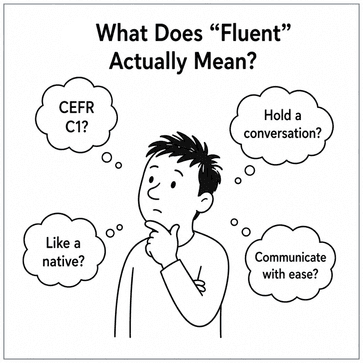
Ask ten people what fluent means, and you’ll get ten answers. Some will point to the Common European Framework of Reference (CEFR), a set of second-language proficiency standards that span from A1 through C2. Some will say “able to hold a conversation.” Some will mean “indistinguishable from a native speaker.” Plenty of certified C1 speakers wouldn’t call themselves fluent, and plenty who couldn’t pass a C1 grammar test communicate fluidly in their second language every day.
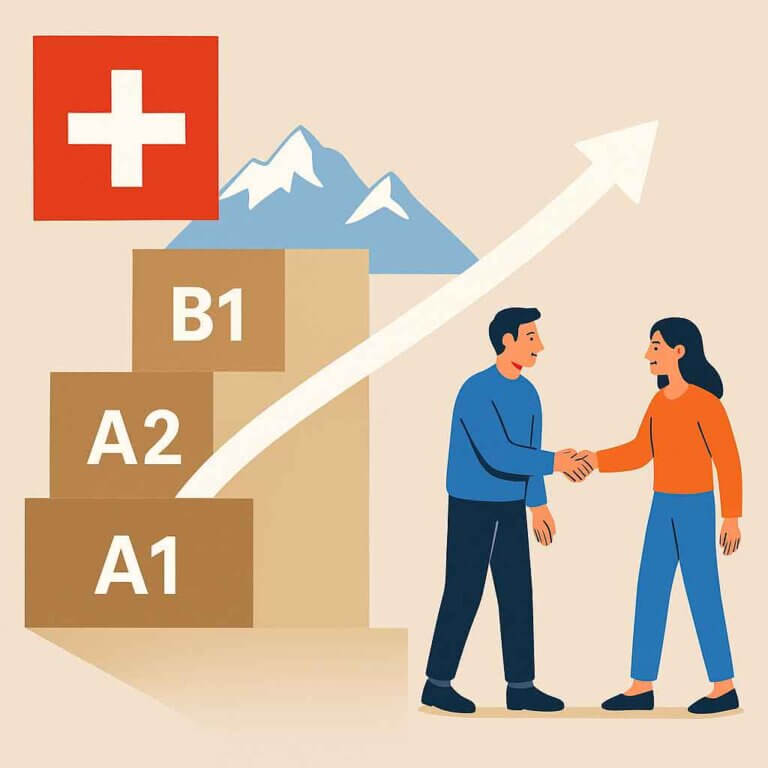
The CEFR levels give us a shared vocabulary for discussing language proficiency, but even within that framework, there’s a significant difference between what an A2 learner can do and what a B2 learner can do, and an even larger gap between B2 and the upper intermediate C1 range. Knowing where you’re aiming matters before you can set realistic goals and a realistic timeline.
What the numbers actually measure
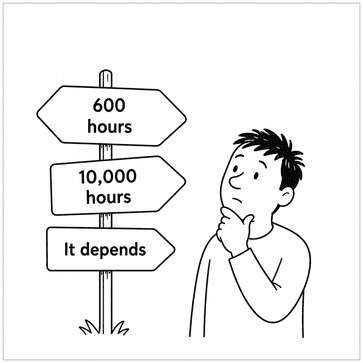
Estimates of total learning time range from 600 hours at the lower end to extremes like the 10,000-hour rule, popularised by Malcolm Gladwell from Ericsson’s expert research applied to language learning. Those numbers should tell you something. They aren’t measuring the same thing that the marketing copy’s measuring.
Is it possible to learn French faster?
Yes. Especially if your goal is basic conversation and autonomy rather than sounding like native French speakers. Most learners can absolutely start speaking, order food, handle simple conversations, and function at a basic level in a relatively short learning time. Will they be considered fluent compared to native speakers? No, and far from it.
How long does it take to learn French to a conversational level?
Our answer is not the time to fluency, but the time to language autonomy. We give you an answer or estimate time below, but have added some context first. If you want, you can skip ahead (link)
What do we actually mean by “learned it”?
When we say a student has learned enough of the French language to keep going independently, we’re not talking about native-level fluency. We’re talking about reaching a threshold of linguistic autonomy. This is the point where people learning French stop feeling like they’re struggling through the thought process and recalling each word, and start feeling like somehow just blurting them out, even if a bit slowly.
With our students, we call this the “click” moment. It happens at different stages and typically in different conditions, usually outside of class. For one student, it came when they had to tell a taxi driver that the fare quoted was incorrect and to use their foundational French to argue. What I’ve typically noticed is that this “click” marks a shift from being aware that they are learning the language to being able to use it, without too much thought, for daily tasks.
At that point, exposure begins to compound. Watching French films, listening to French music, reading, and speaking French become progressively easier. The language begins to contribute to its own acquisition.
What do the larger language schools say:
A1: To reach an A1 level, learners typically need between 100 to 150 hours of study, while an A2 level requires approximately 180 to 200 hours.
B2: B2 level is often considered the threshold for fluency, requiring around 500 to 600 hours of study, allowing learners to work in French and handle most social situations comfortably.
C1: C1 level typically requires 700 to 800 hours of study, enabling learners to communicate effectively in most situations, while C2 level, which focuses on mastery, requires 1000 to 1200 hours.
The Foreign Service Institute (FSI) estimates that reaching professional working proficiency in French requires approximately 600-750 hours of dedicated study and practice.
Overall: Reaching basic fluency in French usually takes about 3 to 6 months, requiring around 250-350 hours of study, while intermediate fluency can take 6 months to 1 year with 500-600 hours of dedicated learning.
| Source | A1 | A2 | B1 | B2 |
|---|---|---|---|---|
| CIEP / France Éducation Int’l | 80h | 135h | 135h | 180 |
| Alliance Française | 100h – 150h | 180h –200h | 350h –400h | 500h – 600h |
| Cambridge English | 90 – 100 | 180–200h | 350–400h | 500–600h |
| FSI / ACTFL (US gov’t) | — | — | — | 600–750h |
While the table does not offer many examples, a broader search reveals many of the same figures repeated across institutions. In many cases, the estimates are presented without detailed methodological justification or clear references to the evidence from which they were derived (such as class sizes, learners’ nationalities, and the duration of classes, etc.).
This does not mean the numbers are necessarily wrong, but it does make it difficult to evaluate how they were produced and how broadly they can be applied.
Academic estimations
Academic linguists such as Krashen, Swain, Ellis, Nation, and Pinker largely avoid making explicit claims about how many hours fluency requires. Where they do converge is on two points: language acquisition is not linear, and the quality of engagement with the language matters far more than raw hours. Motivation, which varies enormously between learners, compounds those differences further. The exception worth noting is Hakuta, Butler, and Witt (2000), whose school immersion data produced concrete timelines, but this is for children in classroom settings, not adult learners.
The criticism here is not that numerical estimates are impossible. We eventually provide one ourselves. The problem is that many published figures are presented as objective benchmarks without clearly defining how they were derived or how much variation exists between learners.
The pattern holds: A notable proportion of the published estimates encountered during this review originated from institutions that also offer courses based on similar timelines.
The FSI and ACTFL estimates occupy a somewhat different category, as they are based on observations of learners in large-scale government language programs rather than commercial course offerings. However, many of the same limitations remain. The published figures are derived from a highly specific population of adult learners operating within intensive instructional environments and pursuing narrowly defined proficiency targets.
While the estimates are based on decades of institutional experience and are often cited as authoritative benchmarks, relatively little public information is available regarding the underlying data used to produce the published ranges. Most public descriptions focus on the proficiency outcomes and training hours rather than learner variance, success rates, or the distribution of results across different populations. As a result, it is difficult to determine how broadly the figures can be generalized beyond the specific training contexts in which they were developed.
AI issue:
AI (in 2026) repeats what’s most published, not what’s most accurate. Ask Claude or ChatGPT how long it takes to learn French, and you’ll get the same institutional figures recycled across a thousand sites. If you push back and ask for the underlying data, it typically won’t have any. It will just restate the consensus more confidently. That’s the problem with using AI to fact-check language learning claims: it mistakes frequency of publication for evidence.
A more useful question
Instead of asking how long until I’m fluent, ask: how long until I have the autonomy to keep learning French on my own?
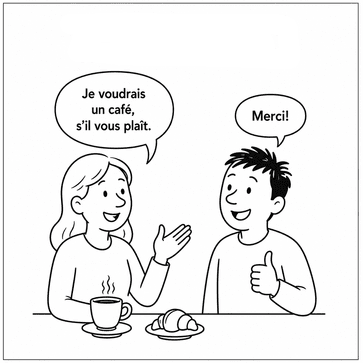
It’s the point where you can hold a simple conversation, read texts at your level, follow slow news in French, and continue without a teacher holding your hand.
Time to reach autonomy?
The number of hours of study, classes, or self-study needed to reach this level varies for each person and depends on a combination of factors, such as environment, access to the language daily, learning process, whether it’s the first language you learn, prior language experience, what language you speak, personality, motivation, and many more.
We’ve had some students reach this level of autonomy in French in roughly 40 hours. But they were Italian, and the similarity between the two languages makes the overall experience much faster. We’ve had other students, native english speaker, who took above-average time, some 80, others 100, to get there. Despite the facility English speakers have with the language. Conversely, we’ve had people whose native language was not European get there faster, despite starting from a point with little to no advantage from their original language.
We generally tell future students 60 hours. Why? Because it roughly falls in the middle of the statistics we’ve collected for this stage of autonomy. When we give this figure, we also include a warning that it is only indicative and can vary significantly from person to person, depending on their effort.
Now, I know we’re going to catch heat for this claim. Most language teachers will disagree, and most of what you’ll find online says it’s out of line with the research. I want to be precise: we are not talking about getting to perfect conversational fluency comparable to a native language speaker, or even reaching B1 or B2 on the CEFR scale.
We’re talking about reaching the conversational fluency needed to have enough autonomy to continue learning French on your own.
What about students who already know some French?
This number is not only confined to complete beginners. While it may seem odd, we get people who have already studied French and can clearly understand it in written form, but are unable to hold even a simple conversation. Typically, this is because they have not had the opportunity, even while learning, to interact with the language verbally.
French doesn’t sound like it reads, and a lack of exposure to the spoken language means that even a student of this type may need about 40 hours to be able to use what they know in autonomous situations.
So, can I learn French in two weeks?
This is central, this figure of 60 hours (or 40, 80, 100), whichever may be closer to your personal aptitude with languages, cannot be done in the space of a month. Some will say, but we can do an intensive course of 20 hours a week for 4 weeks. Therefore, 80 hours. Others may do even more intensely.
Unfortunately, this is not how languages are learned. The brain needs time to process information. We learn as much in our sleep as when we are awake. We need sleep to process active short-term information into subconscious long-term information. That is where real language acquisition rests. The average person’s brain cannot absorb a large quantity of data. So going over the top is not beneficial.
Clearly, if you can take 20 hours of French lessons a week for 3 months, you will progress. But there is a stronger likelihood that the progress is more linked to the three months than to the 20-hour intensity.
What do I mean by autonomy?
What we mean by autonomy is the point at which a learner no longer depends on structured instruction to continue progressing.
We consider a learner autonomous when they can:
- Core indicators of autonomy
- sustain a basic conversation on familiar topics even with lots of structural mistakes;
- work without constant translation;
- infer the meaning of unfamiliar words from context;
- continue acquiring vocabulary without direct instruction.
- beginning to self-correct
- increasing intuition for verb patterns
- growing sensitivity to grammatical constructs (syntax, conjugations)
One observation we can make is that, because of Swiss migration requirements, many of our students have subsequently sat FIDE language evaluations. A Swiss language proficiency test. Among students who completed the beginner level program and sat the FIDE assessment, A2 outcomes were consistent. That’s an independent government evaluation, not our own measure.
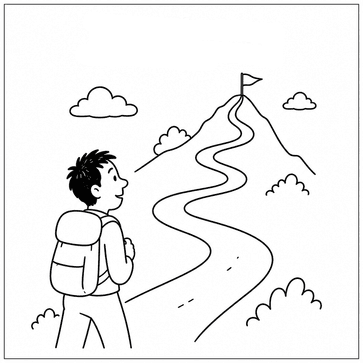
Structure and consistency matter more than hours
So I don’t need classes?
You can learn a new language without classes. People do it through pure exposure, such as living in a French-speaking country, speaking French in day-to-day situations, watching French TV, and listening to French music. However, these methods often do not help much if the foundation has not been built.
A structured approach at the beginning solves a problem immersion alone doesn’t: it gives you the scaffolding to make sense of what you’re hearing once you start consuming the language independently. Without that scaffolding, you can spend years in a French-speaking environment and never move past survival French.
Does fluency mean knowing all the grammar rules? No.
Native speakers use grammar correctly without understanding the theory behind it. Conversely, some students understand French grammar extremely well but still freeze the moment they need to practice speaking French with native speakers. Grammar knowledge is not the same as language proficiency. It’s a component, not a proxy.
Frequency
Will a one-hour lesson a week work? Usually no.
Learning speed matters, but what matters most is consistent effort, not the intensity of any single session.
I’ve had students with a lot of natural ability for language learning who progressed extremely slowly because they constantly cancelled classes or showed up once a month and expected momentum to carry them. They often couldn’t understand why they saw so little progress. I’ve had other students from non-romance language backgrounds, with heavy accents and genuine difficulty, who have moved surprisingly fast because they put in serious work between sessions. Regular practice between classes closes gaps that talent alone never will.
And it’s that consistency that also makes our hour estimate possible at all.
Personal evidence
The best way to describe what autonomy feels like in practice is through experience rather than definition.
I grew up in a French-speaking country. My parents primarily spoke English at home, so I picked up a bilingual French-English foundation early. My mother grew up in Mexico and speaks Spanish. Despite her speaking Spanish with me in childhood, the language never quite stuck beyond the basics.
Then, in my twenties, I lived in Colombia. Nobody around me spoke anything but Spanish. Within three months, I was proficient, not because of natural talent, but because there was no alternative. Hundreds of hours of conversation, daily practice speaking, and the brain adapts when communication is a daily necessity.
The key detail: by the time I arrived in Colombia, I had a solid lower proficiency in Spanish from exposure. That gave me just enough autonomy to learn at the pace immersion allowed, to make mistakes without shutting down, and to infer meaning. That’s the threshold we’re describing.
Learning a second foreign language
A few years later, I learned Italian. I didn’t take formal classes. A friend and I did a self-learning course together. No teacher. Around 80 hours in, we weren’t proficient by any rigorous standard, but we could speak with Italians. (Italians are polite, so it’s hard to know exactly how much credit to take.)
More importantly, those 80 hours had given us the autonomy to keep going. I read the entire Harry Potter series in Italian, listened to the audiobooks, and built comprehension through pure input over months. My speaking lagged because I had nobody to practice with, and I didn’t make much effort to change this, but the foundation was solid.
That’s the pattern: a structured start, then independent input, then real-world speaking when the opportunity arises. None of it happens in two weeks.
These aren’t offered as proof of the hours involved — personal experience can’t do that job. They’re meant to show what the autonomy threshold looks and feels like before we turn to what we’ve seen across students.
Experience from the classroom
I’ve been teaching French and English for the better part of a decade, and since 2022 at our own school. Here’s what we’ve consistently seen with French:
Students coming from Romance languages like Spanish or Italian have reached a functional threshold faster, in several cases within 45 hours. To the point where they no longer strictly need structured lessons to continue.
Students coming from other language backgrounds such as, Chinese, Japanese, Urdu, take longer overall, but they reach the same structural threshold. They leave with the same ability to continue independently; they just need more hours to get there. The learning experience differs, but the destination doesn’t.
For most learners starting from scratch with no romance language base, our realistic timeline sits at 60 to 80 structured hours to reach genuine learning autonomy.
Why the studies disagree
There’s no consensus in the academic literature on how long it takes to learn a language because there’s no consensus on what they’re measuring. Some studies test grammar judgements. Some test ultimate attainment. Some assess language skills in conversational contexts. Some look at academic language use under examination conditions.
These findings aren’t contradictory. They’re answering different questions, with different populations, under different conditions.
The other issue: grammatical accuracy is a poor proxy for fluency. After many years of teaching, I’ve watched students at a C1 level still make grammatical mistakes and common mistakes that a B1 student would catch on a written test. They speak fluidly, work in the language, live in it — and still miss a past-participle agreement occasionally. Native French speakers do the same. Conversely, you can find a student who reads grammar books and aces written tests but freezes the moment they need to order coffee. Grammatical fluency and language fluency are not the same thing.
Slow, careful speech isn’t fluency either. Someone who pauses to think before every word can be 100% grammatically correct and still not be considered fluent. They’re just being careful.
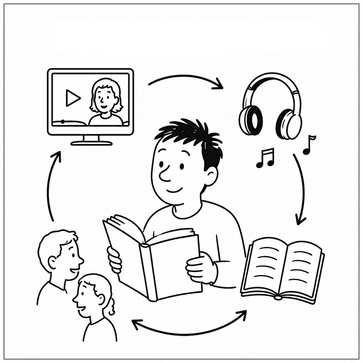
After you reach the autonomy threshold?
Once you’re past the basic level, the most underrated part of learning French is what happens outside the classroom. Watch French movies. Listen to French music. Speak in a local bakery, follow conversations with friends and colleagues, and keep exposing yourself to the French language in contexts that matter to you.
For students aiming at intermediate fluency or beyond, this kind of regular practice is what separates those who plateau and those who keep moving. As you understand more, the little language you know starts opening the doors to more language.
The best method is the one you’ll actually stick with. If Duolingo, Rosetta Stone, personalized lessons, conversation groups, or watching French language films keep you engaged in a way that grammar drills don’t, lean into it.
What about native-level fluency?
If by fluent in French you mean indistinguishable from a native French speaker, the honest answer is: thousands of hours of intense, immersive use. Hartshorne, Tenenbaum, and Pinker’s 2018 study of nearly 670,000 English speakers found that grammar-learning ability stays close to peak until around age 17 to 18 and then declines; to reach native-like proficiency in a second language, you essentially need to start by age 10 to 12 (Hartshorne, Tenenbaum & Pinker, 2018). For an adult learner, native-like is a moving target you may never quite hit.
Native-level French is not the same as professional working proficiency. You don’t need native-level proficiency to use French effectively for work, travel, building relationships, and discussing complex topics. You need autonomy. After that, you keep growing for as long as you keep showing up.
The honest answer
If a French school or app promises fluency in four weeks, they’re either selling you something or they’re using “fluency” to mean something so weak it isn’t worth buying.
The question to ask is:
How many hours until I can keep going without them?
This will vary on several factors, including school, study methods, apps, or self-learning materials, but in our opinion, that is one of the most important questions to ask oneself.
Before you start a course, ask:
- What will I attain by the end of these 20, 30, 40 hours?
- What will I be able to do with what I have learned? (If the answer is conjugate the verb Avoir, then I would question the quality of the school.)
- Will I be able to manage simple routine tasks on my own?
Sources
- Eaton, S. E. (2011). How Long Does it Take to Learn a Second Language? Applying the “10,000-Hour Rule” as a Model for Fluency. University of Calgary.
- Ericsson, K. A., Prietula, M. J., & Cokely, E. T. (2007). The Making of an Expert. Harvard Business Review, July–August.
- Hakuta, K., Butler, Y. G., & Witt, D. (2000). How Long Does It Take English Learners to Attain Proficiency? UC Linguistic Minority Research Institute Policy Report 2000-1.
- Hartshorne, J. K., Tenenbaum, J. B., & Pinker, S. (2018). A critical period for second language acquisition: Evidence from 2/3 million English speakers. Cognition, 177, 263–277.
- Krashen, S. D. (1985). The Input Hypothesis: Issues and Implications. Longman.
- Language Testing International / ACTFL. How Long Does It Take to Become Proficient? (Adapted from Liskin-Gasparro / Foreign Service Institute categorizations.)