
French Level Test — Free Online Placement Test
Free French Level Test
Test yourself with a free online French level test to find your CEFR placement (A1, A2, or B1) and see how well you understand and respond in French.
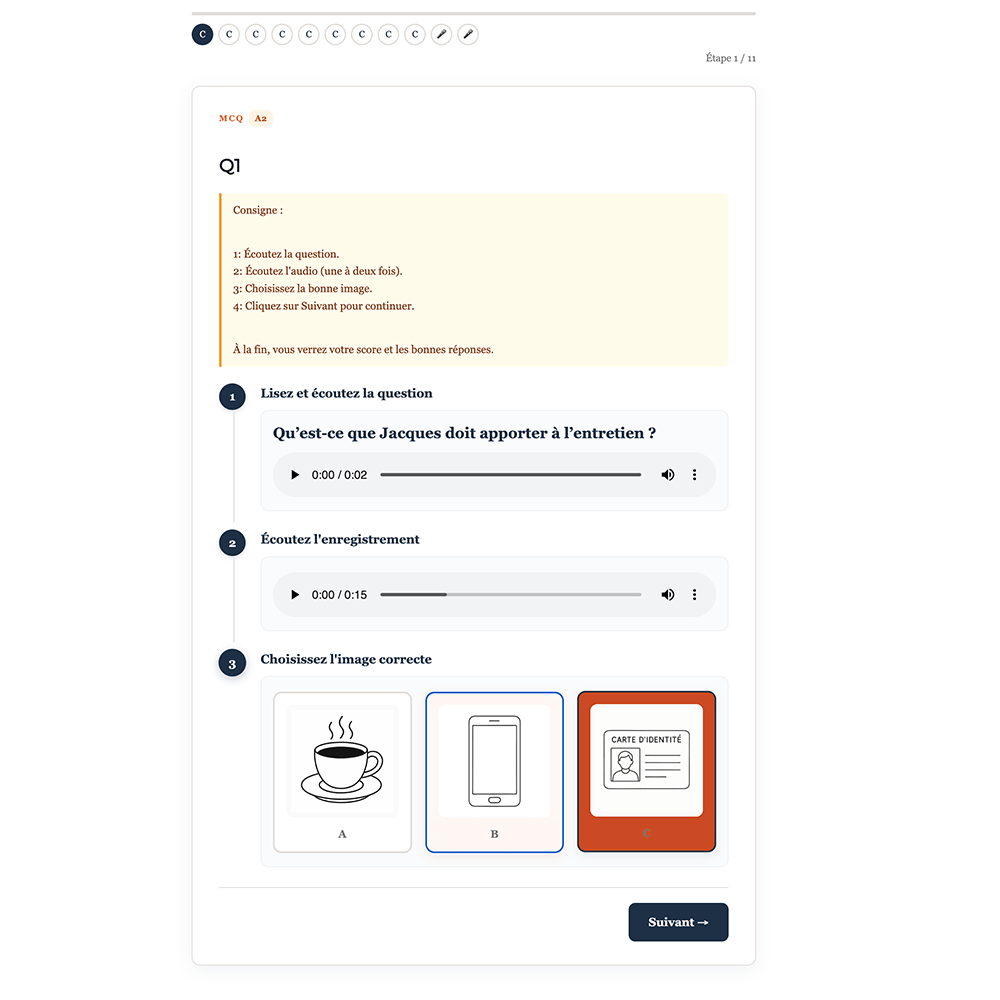
Find your French level with our free online placement test. This French level test measures how well you understand French and respond to it — not whether you can spot grammar mistakes in isolated sentences. It’s the way official exams like FIDE, DELF, and TCF score.
The French placement test is exam-agnostic: useful whether you’re preparing for an official French test, choosing a French course, or just want to know where your French language skills currently stand. Take the writing test, the speaking test, or both.
How this French placement test works
What this French language level test measures
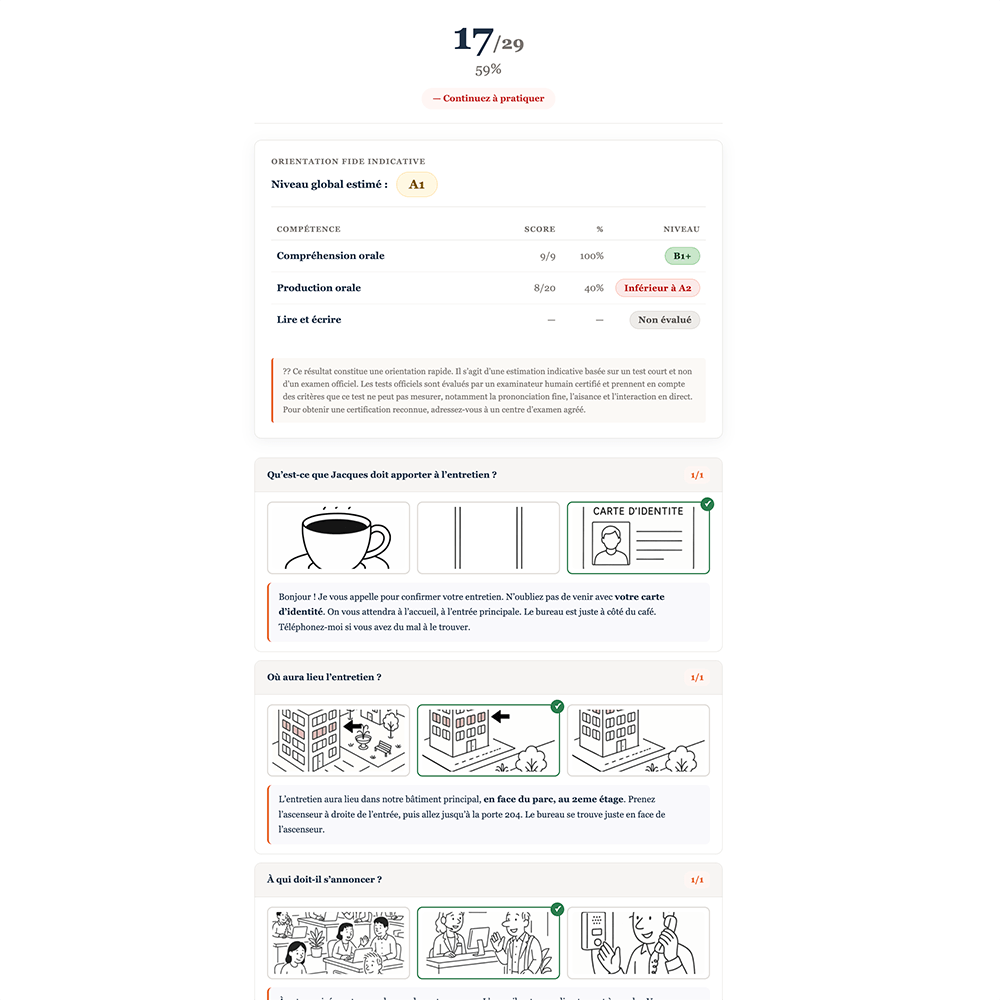
Most online tests ask you to identify the right verb form in an isolated sentence. That measures one narrow skill — grammar recognition — and it’s the skill that fades fastest under exam pressure. This language level test measures something different: your overall capacity to understand French and respond in a way that makes sense.
You read short texts in French (a message, a notice, a short article). You listen to short audio prompts. You respond in writing or by speaking. The test scores you on whether you understood the message and whether your response is coherent and relevant. Grammar accuracy still counts, and we weight it more as the questions get harder — because that’s how official proficiency tests themselves score — but the primary signal we track is comprehension and response.
Language levels explained
French levels explained — A1, A2, B1
This French level test places you on the Common European Framework of Reference for Languages (CEFR) scale — the European standard for measuring proficiency in languages, including French. The CEFR includes six levels, ranging from A1 (beginner) to C2 (proficient). This test focuses on the A1 to B1 range, which covers the levels most commonly needed for everyday communication, work, and Swiss FIDE language requirements.
A1 — Beginner French
Beginner French
At A1, you can introduce yourself, ask and answer simple questions about personal details, and interact in basic everyday situations — as long as the other person speaks slowly and clearly. Typical A1 phrases:
“Je m’appelle Sophie.” • “J’habite à Paris.” • “C’est combien ?”
A2 — Elementary French
Elementary French
At A2, you handle most simple everyday situations — shopping, transport, work, and family. You describe your environment in simple terms and follow short routine exchanges. Typical A2 phrases:
“Je voudrais…” • “Comment je peux faire ça ?” • “Demain je vais à la banque” • “Oui, c’est ça.”
B1 — Intermediate French
Intermediate French
At B1, you communicate independently in familiar personal and professional situations. You describe experiences, give reasons for opinions, and handle most situations that arise while travelling or living in a French-speaking environment. Typical B1 phrases:
“Je pense que…” • “Mais il faut aussi…” • “Lui, il pense que c’est différent.” • “Son idée est intéressante.”
Definition
How this test differs from other online language tests
| Typical online French quiz | This French level test |
|---|---|
| Pick the correct verb form on an isolated sentence | Respond to open-ended prompts in French |
| Multiple choice questions on grammar points | Open-ended writing and speaking tasks |
| Level based on Grammar accuracy | Tests comprehension and response |
| Level based on French grammar accuracy | CEFR proficiency level based on overall communicative ability |
Many learners who score well on French grammar quizzes still freeze in conversation. Many who hesitate on grammar questions handle an actual conversation fine. Official proficiency tests know this — they measure comprehension and response, not rule recall. So do we. The trade-off: this French test takes longer than a typical online quiz, because measuring comprehension and response takes longer than ticking a box.
The placement test
Take the test when you have time to do it properly
There are two separate tests. You can take one, the other, or both. Each test takes around 20 minutes — longer than a typical online quiz because it measures comprehension and response, not isolated grammar. Take it when you have time to focus. There’s no obligation, no account needed before you start, and the result is shown on screen as soon as you finish.
Online French test — Writing
Written comprehension & response
Plan for 20 minutes · A1 to B1
You read short texts in French (a message, a notice, a short article) and respond in writing to prompts based on what you read. The writing test grades you on vocabulary range, sentence structure, accuracy, and whether your response answers the question.
Online French test — Speaking
Spoken comprehension & response
Plan for 20 minutes · A1 to B1 · microphone required
You listen to short audio prompts in everyday situations and respond by speaking aloud into your microphone. The test uses speech recognition with a live transcript on screen — you can see exactly what was heard and re-record if it mishears you.
Test instructions — before you start the tests
The writing test needs nothing more than a keyboard. The test for speaking uses your microphone and speech recognition. To get an accurate result on the speaking part:
- Use a working microphone. Built-in laptop microphones are fine; headset microphones are better.
- Speak clearly and at a normal conversational pace — not too fast, not too quiet.
- Watch the live transcript on screen as you speak. It shows what the system heard.
- If the transcript doesn’t match what you said, repeat the answer before submitting.
- Find a quiet space if you can — background noise interferes with the recognition.
The transcript is your safety net. If the system misheard you because of microphone or noise issues, you’ll see it on screen and can re-record. A wrong transcript means a wrong score — don’t skip past it. Bonne chance.
Who this French language test is for
For French exam preparation (FIDE, DELF, TCF, and other proficiency tests)
This is a general French level test. It’s useful for anyone who wants to test their current French proficiency level — for a specific exam, before starting a French course, or to track progress in learning French.
For French exam preparation
If you’re preparing for an official language test, this placement test gives you an indicative CEFR level before you sit the exam. The CEFR scale is the same framework used by FIDE, DELF, DALF, TCF, and most other recognised French proficiency tests. Knowing your current level helps you choose the right exam target and the right preparation pathway.
Before starting a new French course
If you’re about to start a French course, taking a placement test first means you enrol at the right level. A French language course at the wrong level — too easy or too hard — wastes time and motivation. The test takes some focused time; choosing the wrong course wastes weeks.
To track your progress when learning French
If you’ve been learning French for a while, retake the level test every few weeks or months. The result is a snapshot of your current French level. Over time, the snapshots become a progress track.
French proficiency tests are more than grammar
Why French grammar isn’t the score
A common misconception about French language testing is that it’s mainly about grammar. It isn’t — at least not at the proficiency level this test measures.
Grammar matters. It always will. But proficiency means using grammar in the service of comprehension and response, not memorising rules in isolation. A learner who builds grammatically perfect sentences but freezes in conversation isn’t proficient. A learner who makes some grammatical mistakes but communicates clearly and is understood is.
This is how official proficiency tests score: comprehension and response first, grammatical accuracy as a supporting metric whose weight increases at higher levels. This test mirrors that approach. Grammar is part of the score, but it isn’t the score.
Placement test before a language course
Why take a level test before booking a language course
A French course at the wrong level wastes time. At too low a level, you cover material you already know; at too high a level, you spend more energy decoding instructions than learning. Neither is the experience of learning a new language well.
A placement test gives you and your teacher an objective starting point. Before you book classes, running a level test helps you start from the right level on day one. At My Linguistics, we use a similar communicative approach during our placement process to evaluate comprehension, response, and overall language use — not just isolated grammar knowledge.
Learning at My Linguistics
My Linguistics is a Geneva-based language school specialising in active and participatory language classes. Our method is built around interaction, listening, and active use of the language from the first lesson — not grammar drills.
The My Linguistics method > French courses in Geneva > Book a free consultation >
Test your French level — free.
No account needed to start. Your result is shown on screen as soon as you finish.