
Understanding the Swiss “État des Lieux”: What Happens When You Enter or Leave an Apartment

French language daily situations – L’état des lieux
Many French learners discover that speaking well does not automatically mean feeling confident in every real-life situation in Switzerland. Highly specific contexts, especially those shaped by local administrative and social practices, can disrupt communication even at a solid B1 level. The issue is rarely grammatical. It lies instead in topic-specific vocabulary and unfamiliar procedures.
This limitation becomes particularly visible in everyday administrative situations in Switzerland or in exam settings such as the FIDE or DELF tests. Candidates may struggle with speaking, listening, reading, or writing tasks, not because their French is weak, but because they are confronted with situations they have never experienced themselves.
In daily life, uncertainty can often be resolved with a phone call or a translation tool. In an exam, when external support is unavailable, gaps in situational knowledge become immediately apparent.
Series – Common daily situations in Switzerland and France
This series focuses on everyday situations in Switzerland that often appear in French language exams, even though learners may encounter them only rarely in real life. In this article, we examine the move-in and move-out inspection (état des lieux), a mandatory and often misunderstood step in renting an apartment in Switzerland.
If you have never rented a home, taken part in an inspection such as the état des lieux, dealt with a property management agency (régie), or recovered a rental deposit (dépôt de garantie), the difficulty is usually lexical rather than linguistic.
The FIDE exam nevertheless assumes familiarity with these processes, which form part of everyday life in Switzerland, even though some of them occur only rarely and may be unfamiliar even to local residents.
The overview below explains how a move-in or move-out inspection works in practice, how rental deposits are regulated under Swiss law, what the one-year holding period implies, and how private liability insurance (assurance responsabilité civile, RC) applies when damage occurs.
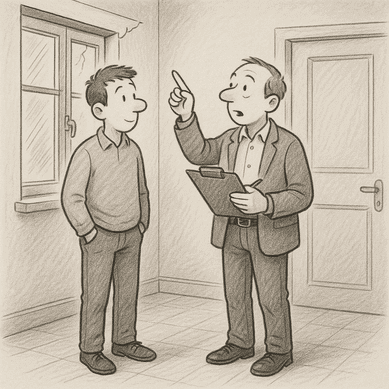
1. What is an “état des lieux” in Switzerland?
A move-in or move-out inspection (état des lieux) is the official inspection of an apartment carried out when a tenant:
- moves in (move-in inspection – état des lieux d’entrée), or
- moves out (move-out inspection – état des lieux de sortie).
Its purpose is to document the exact condition of the apartment, including the walls, floors, fixtures, appliances, windows, doors, ventilation, and level of cleanliness.
This document is not a bill. It serves as the reference point in the event of a disagreement about damage or cleaning.
This procedure reflects standard tenant–landlord practice in Switzerland and aligns with the guidelines of the Swiss Tenants’ Association (ASLOCA), which treats the move-in or move-out inspection (état des lieux) as objective evidence of the apartment’s condition at the beginning and end of the rental period.

2. How a typical état des lieux works
Step 1. Meeting with the régie or landlord
The tenant and a representative of the régie (property management) walk through the apartment together. The inspection can last from 20 to 45 minutes or even longer, depending on the size of the property.
Step 2. Room-by-room evaluation
The inspector checks:
- walls – holes, stains, scratches
- floors – scratches, broken tiles, wear
- windows and shutters – functionality and damage
- lights and electrical outlets
- kitchen appliances – oven, fridge, extractor hood
- bathroom – taps, shower, ventilation, silicone joints
- general cleanliness
Any issue is written into the report. At move-out, the régie distinguishes between:
- usure normale (normal wear), and
- dégâts (tenant-caused damage).
Step 3. Photos, questions, and comments
Tenants may ask for explanations or contest an entry before signing. They may also add their own remarks to the document.
Step 4. Signing the report
At move-in, tenants usually have a few days to report defects they discover later (this varies by régie).
At move-out, the report becomes the basis for any claim related to cleaning or repairs.
Some vocabulary you may encounter:
- “Vous avez ajouté une remarque pour la salle de bain.”
(“You have added a comment about the bathroom.”) - “De la peinture manque ici.”
(“Some paint is missing here.”) - “Et son état sera vérifié à la sortie.”
(“And its condition will be checked at move-out.”)
If this process feels unfamiliar, it is worth practising how to describe it aloud. Being able to explain what is checked, what is noted, and what happens next is often more important than knowing complex grammar.

3. What happens when damage is found?
Damage identified at move-in (état des lieux d’entrée)
When damage is identified during the move-in inspection (état des lieux d’entrée), it must be documented precisely. The purpose is not to assign responsibility, but to establish a clear starting reference.
Tenants should mention everything, even minor issues:
- marks or scratches on the walls,
- holes or stains,
- scratches on kitchen surfaces or appliances,
- incomplete cleaning,
- damaged fixtures or fittings.
Nothing is too small to report. Any visible issue should be written into the inspection report and, when possible, supported by photos. This protects the tenant later, as the move-out inspection (état des lieux de sortie) will compare the apartment’s condition against this initial record.
Damage identified at move-out (état des lieux de sortie)
At move-out, the representative of the property management agency (régie) checks the apartment room by room and compares its condition with the original move-in report.
Unless otherwise agreed in writing, the apartment must be returned in the same condition as at entry, allowing for normal wear and tear. Any changes made by the tenant, such as additional lighting or fixtures, may need to be removed.
If damage is identified, the régie may:
- ask the tenant to organise repairs,
- or propose to handle repairs or cleaning themselves.
It is important to note that services organised by the régie are often more expensive than those arranged independently by the tenant.

4. Typical Examples of État des Lieux Situations
Example A – Normal Move-In
A tenant arrives at a new apartment in Zurich, in the Swiss German part of Switzerland, near the Rhine. They walk through each room with the agent. Small marks on the wall are noted, a window that does not close properly is listed, and both parties sign the document. The inspection is calm, practical, and quick.
This type of calm, procedural exchange reflects what candidates may be expected to understand or reproduce at the A1 or early A2 level.
Role play:
Agent: Bonjour. Nous allons faire l’état des lieux.
Tenant: Bonjour. D’accord.
Agent: Les murs dans le salon sont en bon état, mais il y a une petite marque ici.
Tenant: Oui, je vois.
Agent: La fenêtre ferme mal. On le note.
Tenant: D’accord.
Agent: Voilà, c’est tout. Vous pouvez signer ici.
Tenant: Très bien. Merci.
Agent: Merci. Bonne journée.
Tenant: Merci, au revoir.
Example B – Problematic Move-Out
A tenant living in central Delémont in the canton of Jura leaves after five years. During the inspection, new scratches on the parquet are identified. The régie compares the condition with the original move-in document. If the damage goes beyond normal wear and tear, it is the tenant who pays for repairs, either directly or via the RC liability insurance.
Role play:
Agent: Bonjour. On va faire l’état des lieux de sortie.
Tenant: Bonjour.
Agent: Il y a des rayures sur le parquet ici.
Tenant: Je vois, mais l’appartement a cinq ans.
Agent: Oui, mais ce n’est pas de l’usure normale.
Tenant: D’accord. Que faut-il faire ?
Agent: Nous allons faire un devis. Vous pouvez contacter votre assurance RC.
Tenant: Très bien, je m’en occupe.
Example C – Disagreement About Damage
Sometimes the two parties disagree, and a neutral expert may be called. Whether in Basel, Geneva, Schaffhausen, or Bern, the procedure is generally the same across Switzerland. Tenants should always keep copies of all documents from the day they move into a new home until at least one year after they leave.
Role play:
Agent: Il faut réparer la porte de douche.
Tenant: Je ne suis pas d’accord. Elle était déjà cassée.
Agent: Ce n’est pas noté dans l’état des lieux d’entrée.
Tenant: J’ai des photos.
Agent: Dans ce cas, nous pouvons demander un expert indépendant.
Tenant: D’accord. Je vous envoie les documents.
Situations like these are useful to practise because they combine fixed vocabulary with predictable exchanges. Rehearsing them helps learners respond more calmly and clearly when a similar situation appears in an exam or real life.

5. How This Appears in the FIDE Exam
Housing situations appear frequently in the FIDE test because they are part of daily life when you live in Switzerland. Below is how l’état des lieux may appear at A1, A2, and B1 levels across speaking, reading, writing, and listening.
A. FIDE A1 – Very simple, concrete situations
At A1, the exam focuses on basic comprehension and simple description. Tasks are strongly supported by visuals, often using a short sequence of images.
Candidates are asked to identify what is happening and to describe visible elements using simple language. In a move-in inspection situation, this may involve recognising that someone is visiting an apartment, noticing a visible problem such as a crack on a wall, and understanding that it is mentioned or noted.
Short, formulaic exchanges may also appear, limited to greetings, simple questions, and brief confirmations, for example, to indicate that a problem already existed.
At this level, the emphasis remains on recognising and producing high-frequency vocabulary such as wall (mur), window (fenêtre), clean (propre), dirty (sale), already (déjà), and not new (pas nouveau).
This is a typical housing topic used to test whether candidates can describe a procedure, explain a problem, and give a personal response using clear, everyday language.
B. FIDE A2 – Handling a problem by phone
At A2, the focus shifts from simply naming objects to managing a short, practical exchange about a real problem in your home.
In this part of the exam, you can expect three types of tasks, all connected to a move-in / move-out inspection (l’état des lieux):
- Task 1 – Describe one image
You look at a single image, for example a tenant on the phone with the property management agency (la régie) about a problem in the apartment. You briefly describe what you see and what you think the problem is (a leak, a crack in the wall, something broken). - Task 2 – Phone role-play
You are told that you will speak on the phone. The examiner plays the role of the property manager (la régie) or landlord. You explain the problems you have noticed in the apartment, ask what you should do, and answer simple follow-up questions. - Task 3 – General questions about your experience
Finally, you answer a few questions about your own experience with move-in / move-out inspections (l’état des lieux) or repairs. Even if you have never done one yourself, you may be asked what you think is important, or what you would do if there was damage.
The useful part is that this A2 section reuses vocabulary that appears in other housing topics, such as asking for repairs or reporting a problem in your building.
C. FIDE B1 – Narrative, explanation, and opinion
At B1, the topic of a move-in or move-out inspection (l’état des lieux)would be used as a starting point for a broader conversation. Candidates are expected to speak more freely and in more detail than at A2.
In the speaking part, this topic can lead to several general types of questions, for example:
- describing a personal experience, including problems or disagreements,
- explaining how a move-in or move-out inspection works, step by step,
- comparing the procedure in Switzerland with practices in another country,
- expressing opinions about costs, fairness, responsibility, or repairs,
- responding to hypothetical questions (what you would do in a given situation).
The focus is no longer on identifying a problem, but on developing an answer: organising ideas, giving reasons, and expressing a point of view. Minor language errors are acceptable as long as the message remains clear.
These tasks correspond to typical B1 expectations: narrating experiences, explaining a process, discussing advantages and disadvantages, and taking a position.
6. Essential Vocabulary for the FIDE (English + French)
| English | French |
|---|---|
| Move-in inspection | état des lieux d’entrée |
| Move-out inspection | état des lieux de sortie |
| Tenant | le locataire |
| Landlord / agency | le bailleur / la régie |
| Apartment condition | l’état du logement |
| Rental contract | contrat de bail |
| Deposit | dépôt de garantie |
| Wear and tear | usure normale |
| Damage | dommage |
| Liability insurance | assurance RC |
| Cleaning | nettoyage |
| To sign | signer |
| To report a problem | signaler un problème |
| Appointment | rendez-vous |
| Entry date | date de début de location |
| Both parties | les deux parties |
| Place / location | lieu |
7. Mock exercises and preparation (A1–B1)
How to prepare
Free resources
The official FIDE website provides a range of free materials, including videos, sample tasks, and explanatory articles. Vocabulary lists are also widely available online. While useful as a reference, memorising isolated vocabulary is rarely effective in the long term.
A more reliable approach is to integrate new vocabulary into simple role-play activities and short, guided conversations. This helps learners move from recognition to actual use and prepares them for exam situations that simulate real-life communication.
Paid resources – Practicing at home or with someone
Structured preparation materials can help consolidate this process.
Our A1–B1 materials focus on topic-based conversation, guided role-play, and targeted vocabulary integrated into exercises. They also include listening, reading, and writing activities, which are effective ways to reinforce vocabulary through repeated exposure and context.
You can practice:
- recreating short phone conversations,
- describing images related to housing situations,
- rehearsing typical phrases used during inspections,
- and answering general questions about personal experience or hypothetical situations.
Exercises (A2–B1)
Individual reflection
Start by thinking about the process based on your own experience or what you know:
- Have you ever taken part in a move-in or move-out inspection (état des lieux)?
- Did you have any problems? If yes, what were they and how were they handled?
- Who did you speak with (property manager, landlord, agency)?
Short answers are enough. The objective is to activate relevant vocabulary.
Role-play practice
Create simple role-play situations, alone or with a partner. For example:
- a tenant meeting the property manager during an inspection,
- a phone call to report a problem in the apartment,
- a discussion about a repair that needs to be done.
Typical exchanges might include greetings, identifying a problem, reacting to it, and closing the conversation. These role-plays are a good opportunity to integrate new vocabulary in context rather than memorising it.
Listening practice
Listening can be practised using free or paid materials, but also through real interaction. Discuss the topic with a friend, explain the process aloud, or listen to someone else describe a similar situation. The goal is to become comfortable recognising familiar words and ideas when spoken.
Reading and writing practice
Reading and writing are particularly useful for this topic. Lease agreements, inspection reports, emails from property managers, and repair requests all contain recurring vocabulary.
Short writing tasks can include:
- confirming an appointment,
- describing a problem in writing,
- summarising what happened during an inspection.
These activities reinforce vocabulary through repeated exposure and realistic use.